
Author: Antonis Alexandrou, Project Manager
We’ve all heard about Artificial Intelligence (AI) by now. Maybe you’ve used it to write an email or seen those perfect AI-generated pictures online. But behind the scenes, a much quieter, incredibly fast war is being fought. And the outcome of this war decides whether your bank account, your medical records, and your favourite websites stay safe from hackers.
It’s no longer a battle of human hackers against human tech support. We have entered the era of AI versus AI.
To understand what’s happening, you don’t need a degree in computer science. You just need to understand how a classic game of cat and mouse has completely changed.
How Hackers Use AI
To understand how we protect ourselves, we must first have to look at how the bad guys are changing their tactics. Hackers aren’t just sitting in dark rooms guessing passwords anymore. They are using AI as a sort of super- helper to do the heavy lifting for them.
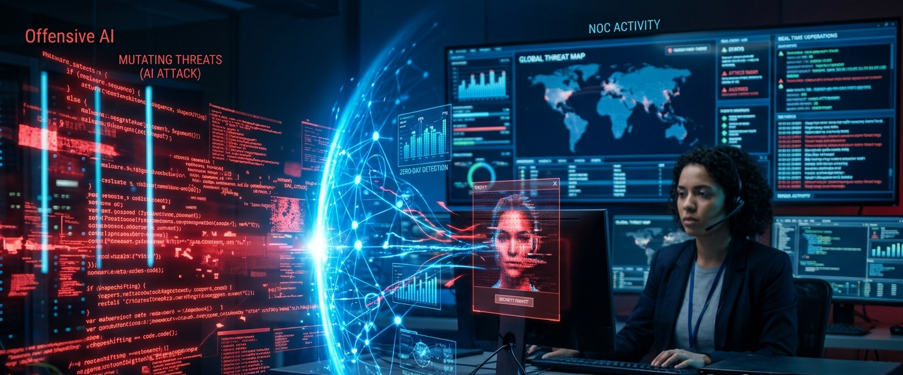
In the past, computer viruses were static. When a hacker wrote a virus, it stayed exactly the same. Security software would scan a computer, find that specific file, and delete it. Today, hackers use AI to build mutating software. Every single time this software enters a new computer, the built-in AI automatically changes the files, rewrites its own code, and renames its parts. Because it looks completely different every time, standard security programs don’t recognize it as a virus and let it run.
AI has also changed how scammers trick people. We used to spot scam emails easily because they were full of bad grammar, typos, or weird phrasing. Now, hackers feed an AI program examples of real emails from banks or specific bosses. The AI studies how those people write and instantly generate a perfect, error-free message. It can even look at your public social media pages to include real details about your life, making the scam look 100% legitimate.
AI-Driven Cyber Defence
If the hackers are using lightning-fast AI to attack, human security teams simply cannot move fast enough to stop them. A human might take hours or days to notice a breach. An AI attack can steal data in seconds.
Because of this, cybersecurity companies have built defensive AI to act like a digital immune system.
Instead of looking for a list of “known bad viruses” (which change too fast anyway), defensive AI spends its time learning what normal looks like for a company. It notices that Maria from accounting usually logs in at 9:00 AM from Athens, checks a few spreadsheets, and logs off at 5:00 PM.
If Maria’s account suddenly logs in at 3:00 AM from an IP address in another country and tries to download every single customer’s credit card number in three seconds, the defensive AI doesn’t wait for a human supervisor to wake up. It instantly recognizes that this behaviour is wrong. It locks Maria’s account and freezes the computer in milliseconds, stopping the hacker in their tracks.
Deepfakes and Deception
The battlefield gets truly bizarre when we talk about identity and trust. We have entered the era of deepfakes, where AI can mimic the voice or video of a company’s CEO. There are already documented cases of employees transferring millions of dollars after being fooled by a live video call featuring an AI-generated version of their boss.
To counter this, defenders are deploying Verification AI. These are algorithms designed specifically to look for the microscopic imperfections in deepfakes, such as unnatural blinking patterns, voice frequencies that humans can’t hear, or pixel anomalies. It is literally an AI auditing another AI to see if it’s lying.
Why Humans Aren’t Obsolete
With machines fighting machines at speeds we can’t even comprehend, it’s easy to wonder: are human tech experts becoming obsolete?
Not at all. In fact, we need them more than ever, but their daily job description has completely shifted. Instead of being the players running around on the field, humans have become the coaches calling the strategy from the sidelines. The AI handles the raw speed, but humans provide the guidelines.
There are three main reasons why humans are still irreplaceable in this fight:
- AI Has Zero Common Sense: An AI is incredibly smart at finding patterns, but it doesn’t understand context, human emotion, or how a business actually runs. For example, if a company’s website suddenly gets a massive spike in traffic because a product went viral on social media, a defensive AI might mistake that sudden rush for a hacker attack. It might panic and shut down the whole website to “protect” it, accidentally costing the company thousands of dollars. A human is needed to step in, look at the big picture, and tell the system to calm down.
- Preventing “False Alarms”: Software updates happen all the time. When a company’s internal tech team rolls out a massive, legitimate update to their system overnight, it looks chaotic to an algorithm. Left on its own, a defensive AI might lock the engineers out of their own computers. Humans act as the ultimate sanity check, supervising the AI’s decisions and hitting the override button when the machine misinterprets a normal business activity.
- Setting the Rules: AI only knows what we teach it. If the data we use to train the security AI is outdated, the AI will have massive blind spots. Human experts are responsible for constantly teaching the AI, updating its knowledge, and steering it in the right direction.
Ultimately, the AI is like a hyper-reactive guard dog. It can spot a threat and react instantly, but it still needs a human owner to look at the situation and decide whether to reward it or tell it to stand down.
An Endless Evolution
The AI vs. AI landscape is not a war that will have a definitive winner. It is a permanent shift in the ecosystem. Every time defensive AI gets better at spotting anomalies, offensive AI will train itself to behave more like a human to blend in.
We are heading toward a future where the security of our banks, hospitals, and power grids will depend entirely on who has the smarter, faster algorithm. It’s a fast, fascinating, and slightly terrifying frontier. However, as long as defenders keep innovating, the shield will hold.








Comments are closed